Meta Ads Creative Testing: A Simple System for More Winners
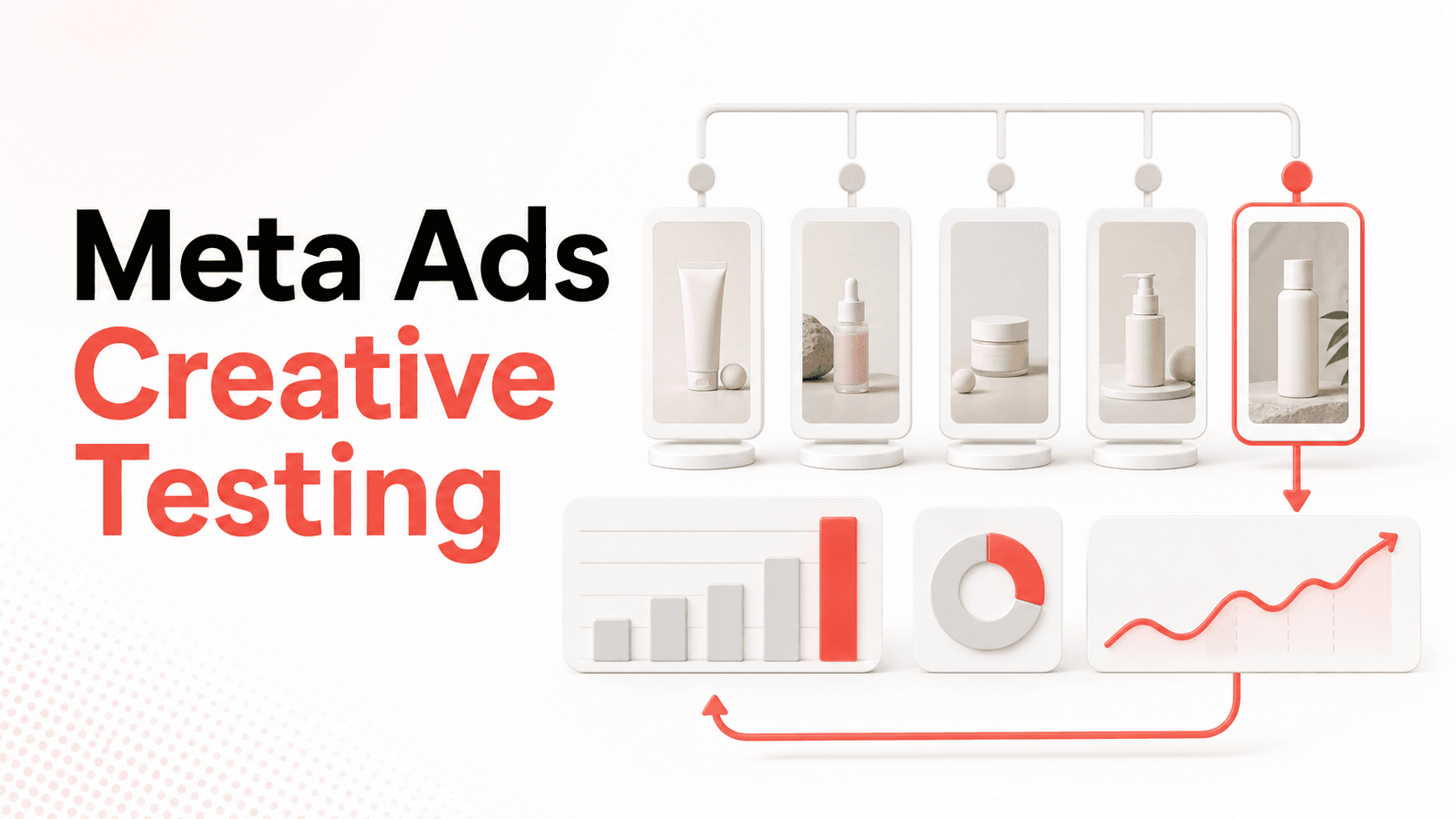
Bottom line: Meta creative testing needs controlled variety. Test different hooks and angles, not random videos. AI helps most when it produces enough structured variants for the algorithm to find a signal.
Start with a creative hypothesis
Each test should answer a specific question: which customer pain, proof point, product use case, or offer framing deserves more spend. Without a hypothesis, creative volume becomes noise.
Write the test around one product and several angles. Keep landing page, offer, and audience mostly stable so the result teaches you about the creative.
Build variants that are different enough
Strong test sets vary the first sentence, presenter, visual framing, proof point, and CTA. Weak test sets only change the caption or background while keeping the same message.
A practical starter set is six to ten ads: two problem hooks, two proof hooks, one comparison, one routine, one founder-style explanation, and one offer-led direct response.
Use results to create the next batch
Do not only scale the winning video. Identify the winning angle, then generate a second batch around that angle with new openings, new presenters, and tighter pacing.
The goal is a creative learning loop: product URL to variants, variants to paid data, paid data to new scripts, and new scripts back into production.
FAQ
How many Meta ad creatives should I test at once?
A focused set of six to ten creatives per product is enough for most early tests. More can work, but only if each creative has a clear difference.
Should I test audiences or creatives first?
For many broad-targeting accounts, creative is the bigger lever. Keep the audience simple and use the creative to find the angle.
What is a creative winner?
A winner is not only the lowest CPA. It is a repeatable angle that can support more variants, more budget, and consistent landing-page intent.